Wuhan shaomai: let the center revise the dumpling category
The shape of an open-topped dumpling can suggest a familiar filling before you read the menu. Wuhan shaomai gives you a reason to pause and identify the center. A filling-led comparison reveals why the same broad dumpling category can produce very different eating experiences across regional traditions.
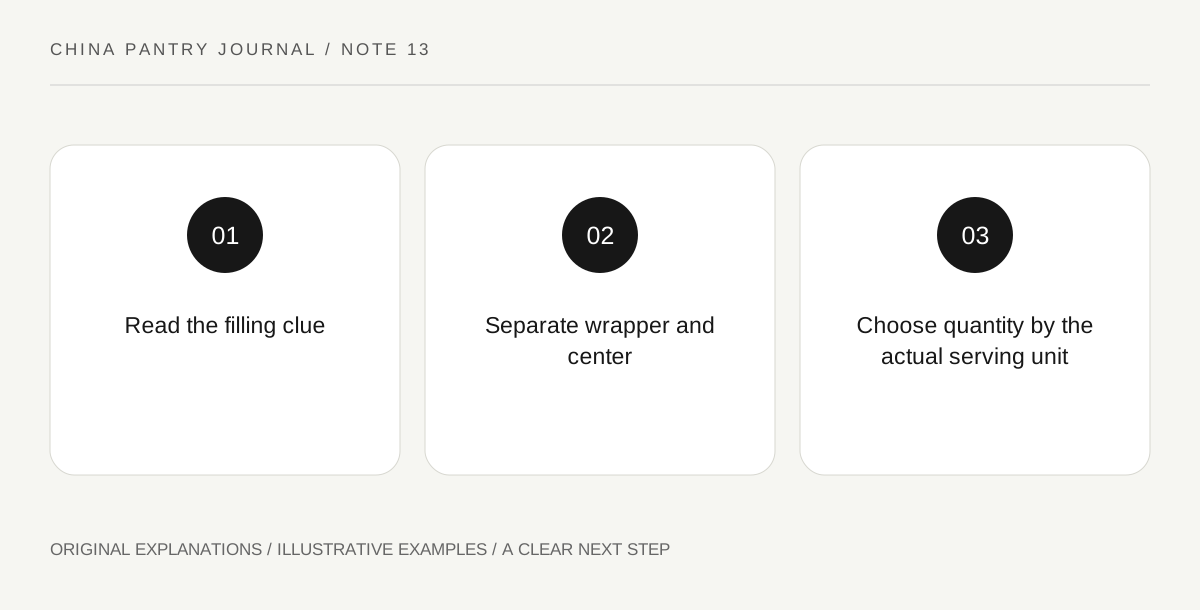
Original explanatory diagram. Read the full method and limitations below.
Read the regional filling clue
Wuhan’s municipal snack guide describes its rich-oil shaomai through a glutinous-rice-based filling. Use that regional description as a starting point and ask for the kitchen’s actual version. An open top may reveal some ingredients while concealing others within the mixture. Keep the full menu name beside any English translation. A brief identification question is more useful than assuming the center matches the first siu mai or shaomai you encountered in a different place.
Draw wrapper and center as separate roles
Make a simple outline with a surrounding wrapper and an interior field. On a suitable portion, describe how the wrapper supports the center and how the center behaves when separated. Do not turn the outline into a claim about precise proportions or technique. The diagram is a way to organize attention, particularly when an unfamiliar filling dominates the bite. It lets you compare two preparations without reducing the difference to a vague statement that one is heavier or more authentic. Their structures can be explained more specifically.
Use the order unit as a practical question
Ask how the shop sells the dumplings: by a stated number, portion, basket or another unit. Then consider the actual portion within the rest of breakfast. A small-looking piece can contain a substantial filling, but the decision about how many to order belongs to your appetite and companions rather than an internet challenge. Begin with a manageable amount and add if wanted. Keeping serving unit separate from individual piece size also makes a bill or shared order easier to understand without inventing a universal basket count.
Make a regional comparison without erasing variation
If you compare this preparation with another regional dumpling, choose three fields: wrapper form, confirmed center and serving format. Write the city or establishment beside each. This preserves the food’s identity while showing why a shared name does not require identical content. End with a personal preference stated as preference. A useful food guide can help someone expect a rice-centered version without telling them that all other forms are wrong or that one encounter represents every kitchen in Wuhan.
Illustrative food notebook
Illustrative breakfast: two companions confirm the shop’s serving unit and order a modest initial portion. Their notebook outline separates wrapper from center, with the rice-based filling description supplied by the kitchen. They compare it later with a different regional dumpling using three explicit fields. The comparison explains variation instead of treating an unfamiliar center as a mistaken version of a familiar snack.
Questions that come up
Does an open top disclose the whole filling?
No. Visible ingredients are only part of the evidence. The actual composition should come from the menu or kitchen, particularly when ingredient details matter.
Is there one standard number of pieces in an order?
This guide establishes no universal serving count. Ask the establishment how the item is sold and choose an amount suited to the meal.
References and scope
These sources support the factual background. Examples and exercises are original illustrative teaching material. References do not imply endorsement.
- Wuhan Municipal Government: Top Ten Wuhan Snacks, rich-oil shaomai entry — The regional shaomai identity and glutinous-rice-based center; no universal recipe or portion count.