Savory mooncakes: place filling and crust on separate axes
A mooncake does not have to fit the sweet, dense image suggested by a familiar gift box. Savory versions provide a useful way to separate the filling choice from the pastry structure. A two-axis notebook helps you describe the particular product without treating one regional expectation as the definition of the whole category.
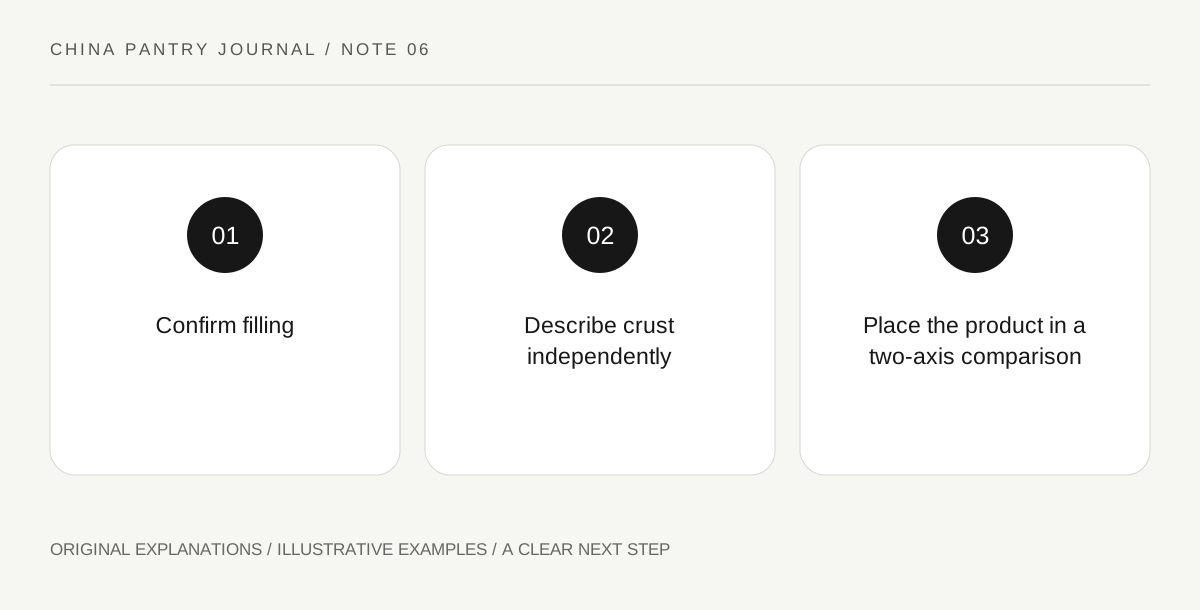
Original explanatory diagram. Read the full method and limitations below.
Use the exact filling as the first coordinate
Shanghai’s official mooncake guide documents fresh-meat and other savory fillings alongside sweet varieties. Begin with the seller’s precise product name and filling description. The word mooncake identifies a broad family and cultural association; it is not a complete answer to what is inside. If buying for companions, write the filling on the bag before it becomes detached from the display label. Do not ask a friend to identify a concealed center from a surface stamp unless its meaning has been confirmed by the seller.
Give the crust its own description
Make a second coordinate for the outer pastry. Observe how it holds together and separates on the particular portion you try, rather than using a filling name as a prediction of every texture. A matrix can have filling across the top and crust description down the side. Put each purchase in one cell with the product’s own name. The point is not to create a universal taxonomy of mooncakes. It is to keep two kinds of information available when you compare products that might share one feature and differ in another.
Choose a purchase format that fits the occasion
A ready-to-eat portion for an immediate snack and a packaged gift have different practical requirements. Ask for the producer’s actual storage and serving directions and consider the recipient’s plans before buying. This article does not supply a shelf life for a product whose filling and packaging are unknown. For a gathering, begin with a modest selection and let guests choose based on the confirmed descriptions. A mixed box is more welcoming when each item remains identifiable and no one is expected to taste every filling.
Make regional variety part of the introduction
When explaining the food to a newcomer, say that this is a particular savory version rather than presenting it as the surprising exception that makes every other mooncake conventional. Food categories vary across places, makers and occasions. Your two-axis record can hold that variety without ranking one form as more authentic. End with a specific observation about the purchased crust-and-filling combination and the context in which you enjoyed it. That is more useful than a sweeping claim about what all mooncakes taste like.
Illustrative food notebook
Illustrative matrix: a buyer records two savory varieties and one sweet variety from clearly labeled products. Each receives a filling column and an observed crust row. The buyer notices that two products share a crust description while their centers differ. At the gathering, the matrix becomes a small menu card, helping guests choose without making the exterior design carry all the ingredient information.
Questions that come up
Does mooncake automatically mean a sweet bean-paste filling?
No. The official Shanghai guide documents a wider variety, including savory products. The exact filling should be read from the particular item.
Does a savory filling establish a single crust type?
Do not assume that one coordinate supplies the other. Read the product description and observe the actual preparation before adding it to your comparison.
References and scope
These sources support the factual background. Examples and exercises are original illustrative teaching material. References do not imply endorsement.
- Shanghai: Savor Shanghai’s delicious mooncakes — Documented examples of savory and sweet mooncakes; does not establish current shop availability or a universal recipe.