Qingtuan: make a filling map before opening the green parcel
Green pastry cases can look nearly identical while holding very different fillings. Qingtuan offers a useful lesson in keeping the outside, the filling and the cultural occasion on separate lines. A small filling map makes a mixed purchase easier to share and lets the pastry’s seasonal associations enrich the meal without dictating what every version contains.
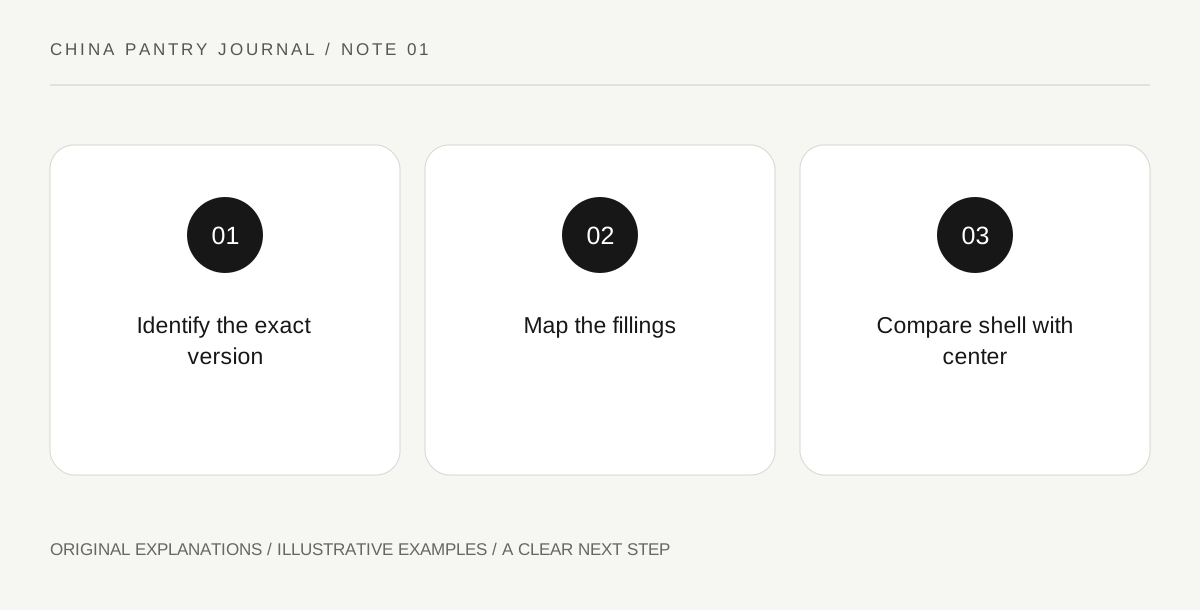
Original explanatory diagram. Read the full method and limitations below.
Let the name establish a starting point
Shanghai’s official introduction identifies qingtuan as green rice balls associated with the Qingming Festival. That gives the pastry a cultural and visual context. It does not identify the contents of every green parcel in a modern display. Preserve the exact menu or package name and add the filling description supplied by the seller. A food notebook becomes more useful when qingtuan is the family name and the individual filling is a separate field. You can then compare versions without silently treating the first one you encounter as the universal recipe.
Create the map while the labels are visible
If buying several varieties, draw a box with the same arrangement as the package and write each confirmed filling in its position. Ask the seller how to distinguish them if the order may shift. Do this before wrappers are removed or the pastries are passed around. A map is particularly helpful when companions choose different fillings but the exteriors offer little information. Do not rely on a tiny surface mark unless the seller confirms what it means. The simple drawing prevents a shared snack from turning into a guessing exercise.
Describe shell and filling separately
For a version suitable for you, use one sentence about the outer layer and another about the center. You might notice resistance, softness or how the two parts hold together; let your actual experience supply the words. Avoid turning an unfamiliar texture into a defect merely because it differs from a wheat pastry. Likewise, a pleasing center does not tell you how the outer layer was made. Two descriptions create a clearer memory than a single score and let companions disagree about preference while agreeing about what they encountered.
Let seasonality guide conversation, not a shopping deadline
A festival association can open a question about when a family or shop enjoys a food, but it does not prove that every seller offers it only during that period. Ask about the specific purchase rather than planning around a generalized seasonal promise. For takeaway, follow the product’s actual storage and serving instructions; a cultural article cannot establish a safe shelf life for an unknown filling. End the notebook entry with the exact version and one personal observation so that a future purchase can be a deliberate comparison.
Illustrative food notebook
Illustrative purchase: three friends choose two confirmed sweet fillings and one confirmed savory filling. The buyer copies the seller’s descriptions onto a box diagram before closing the lid. At the table, the group uses the map instead of guessing from the green exterior. Their notes compare how each center changes the balance of the bite, while keeping the shared outer appearance as a separate observation.
Questions that come up
Does the green exterior mean the center is sweet?
It does not answer the filling question. Use the exact product description and confirmation from the seller rather than appearance alone.
Can I compare qingtuan without choosing a favorite?
Yes. Describing how shell and center interact is useful in itself. A comparison can preserve differences without ranking every version from best to worst.
References and scope
These sources support the factual background. Examples and exercises are original illustrative teaching material. References do not imply endorsement.
- Shanghai: Qingtuan — The green rice-ball identity and Qingming association; not a universal filling or storage rule.