Chongming cake: read a slice as a cross-section
A slice of Chongming cake can reveal its structure more clearly than a photograph of the whole cake. Treat the cut surface as a small landscape of rice body and added pieces. The exercise helps distinguish what the particular slice contains, how it is served and which questions a decorative outer surface cannot answer.
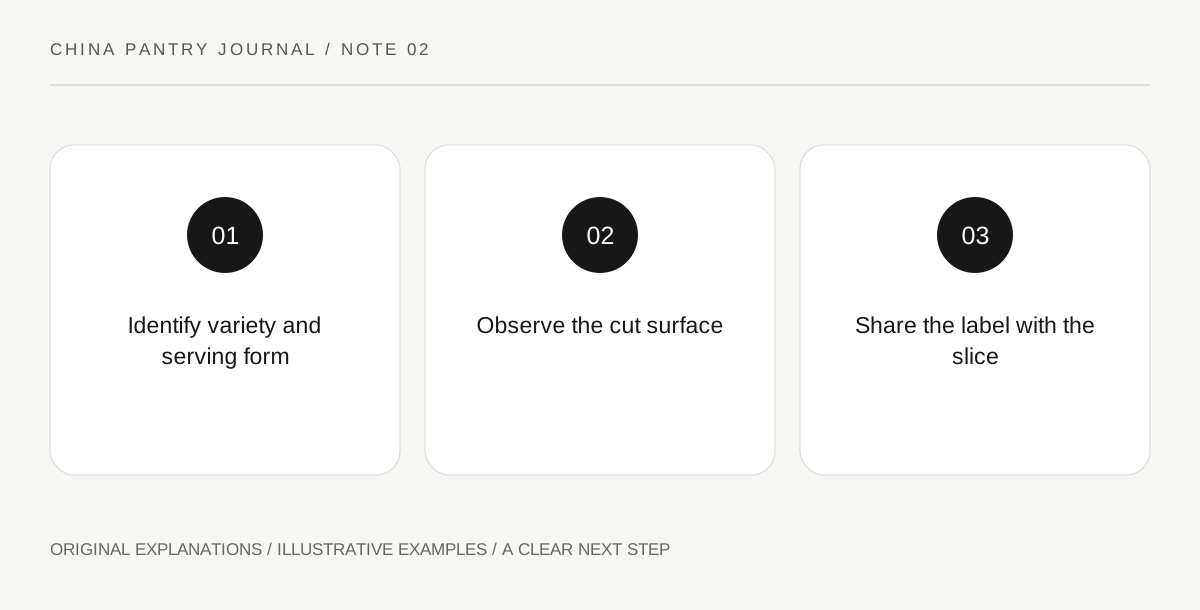
Original explanatory diagram. Read the full method and limitations below.
Establish the specific preparation
Shanghai’s official account describes Chongming cake as a steamed regional rice pastry with hard and soft varieties. It also gives examples of fruits, beans, nuts and seeds used in versions of the cake. Use that account as context rather than a compulsory ingredient list for every slice. Ask the seller which preparation you are buying and how it is intended to be served. A firm gift cake and a softer ready-to-eat portion may call for different expectations, even when both share the same regional name.
Read three zones on the cut face
On a portion suitable for you, look at the outer edge, the central rice body and any visible inclusions. Describe where they occur and whether they form layers or a scattered pattern. A picture can record distribution, but it cannot identify every ingredient confidently. Keep an unknown dark piece as unknown until the seller or label supplies the name. This method is especially useful in a gift assortment, where a decorative top may suggest one ingredient while the interior contains others that are harder to distinguish.
Let serving form enter the comparison
Compare the product as served, not as a timeless object. Note whether the slice is presented ready to eat or with preparation instructions. If the seller gives a serving method, follow it rather than inventing one from a generic recipe found for a different variety. You can compare two purchases by writing the serving condition beside the texture note. That makes a later discussion more precise: a difference may concern the particular variety or presentation, rather than proving that one shop has made an entire regional tradition incorrectly.
Make a gift explanation useful
When sharing the cake, include the exact product label and the serving information supplied with it. Add a short cultural introduction and a simple description of the slice rather than making promises that every guest will enjoy the same texture. Portioning is a hospitality decision that depends on the rest of the meal and the guests’ preferences; there is no need to turn it into a universal rule. A thoughtful gift note helps recipients understand what they received and what information still needs confirmation from the producer.
Illustrative food notebook
Illustrative gift note: a buyer selects a labeled Chongming cake and keeps the producer’s serving directions with the box. They describe a sample slice as a pale rice body with visible scattered inclusions, naming only those confirmed on the label. At a gathering, the host offers modest initial portions alongside the label. Guests can learn the cake’s structure and decide whether they want more without being told what they ought to prefer.
Questions that come up
Does every Chongming cake contain the same dried fruit?
No fixed ingredient list is established by the regional name. Read the particular producer’s description and confirm details relevant to your needs.
Is firmness automatically a quality problem?
The official description distinguishes varieties with different serving forms. Assess the actual product against its stated preparation rather than assuming all versions should feel identical.
References and scope
These sources support the factual background. Examples and exercises are original illustrative teaching material. References do not imply endorsement.
- Shanghai: Chongming Cake — Steamed rice-pastry identity, hard and soft varieties, and examples of inclusions.