Mung-bean cakes: use a crumb vocabulary instead of expecting sponge cake
Cake is an exceptionally broad English label. A mung-bean cake can invite a different texture expectation from a baked sponge or a layered celebration cake. Build a small vocabulary around the actual piece: how it holds its shape, how it breaks and how its ingredients are described on the label.
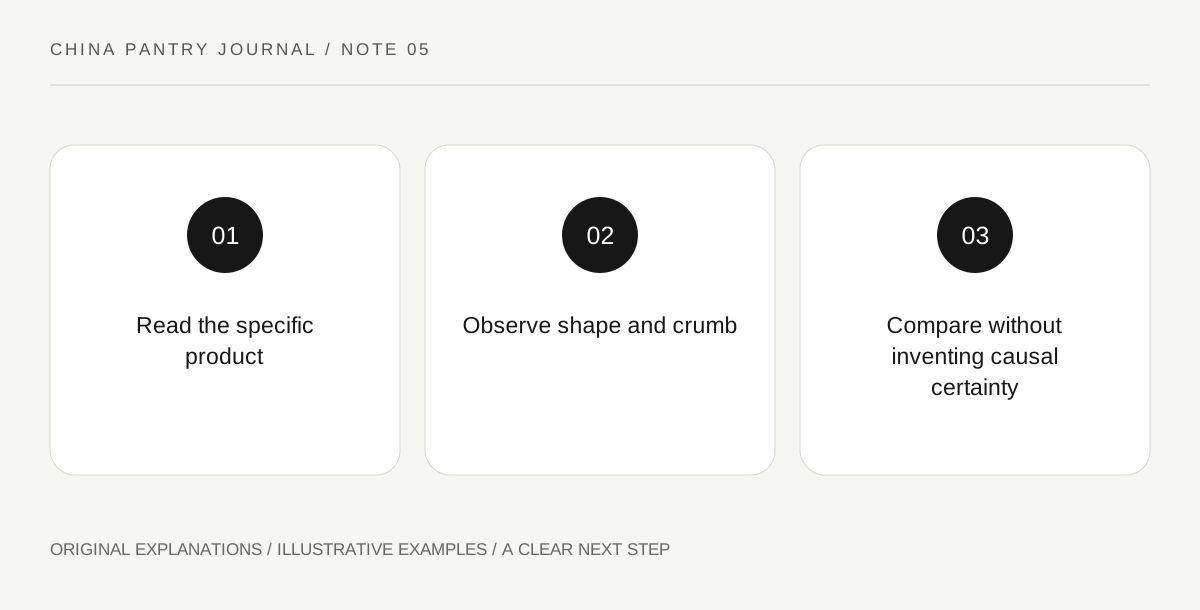
Original explanatory diagram. Read the full method and limitations below.
Separate the food family from a single formula
Shanghai’s official introduction describes a mung-bean cake made from a paste with butter and sugar. That is an example of a preparation, not evidence that every product with the name uses an identical formula. Read the particular label and keep its details beside the name. The exercise is especially useful when several products look similar but come from different producers. A familiar ingredient in the name tells you the subject of the food, while the complete formulation still belongs to the actual maker’s information.
Describe shape-holding and breaking separately
Look at the molded piece before taking a suitable bite or cutting a portion. Does it retain a sharp pattern, a smooth outline or a softer edge? Then describe how the portion separates. These two observations concern different properties: how it is presented and how it behaves when eaten. Avoid judging the food solely by whether it resembles the springiness of a wheat sponge. A neutral vocabulary gives you room to appreciate a fine, dense, crumbly or paste-like structure if that is what the particular product actually offers.
Make a comparison with one controlled difference
If you have two labeled varieties, choose one question such as the effect of an added flavor or a different serving presentation. Keep the rest of the comparison modest: similar portion, the actual stated variety, and an observation made without requiring an elaborate tasting event. Do not conclude that every difference comes from one ingredient unless you know the formulations are otherwise the same. The useful outcome is a clear description of two products, not a scientific experiment pretending to isolate a cause it cannot control.
Serve the label as part of the hospitality
At a shared table, present the pieces with their names and retain the ingredient information. Let guests choose their portions and use whatever accompanying drink suits the gathering. There is no need to claim that one pairing is mandatory or that the pastry has a cooling or restorative medical function. A food can be culturally interesting and pleasant without a wellness promise. Finish your notebook with a few precise texture words and a sentence about the particular product, leaving the category open for a different version on another occasion.
Illustrative food notebook
Illustrative comparison: a host buys two clearly labeled mung-bean cake varieties and places them on separate small plates with the packaging nearby. One notebook field describes the molded appearance and another the way a portion breaks. The group notices different added flavors but does not attribute every texture difference to those flavors. The host keeps the exercise conversational and allows guests to enjoy a single variety or none.
Questions that come up
Is a dense texture a sign that the cake failed to rise?
That question imports a sponge-cake expectation that may not fit the product. Understand the maker’s intended preparation before judging it against another kind of cake.
Can I identify every ingredient by tasting the piece?
Taste is not a complete ingredient record. Use the label or producer’s information when composition matters, and keep sensory impressions as personal descriptions.
References and scope
These sources support the factual background. Examples and exercises are original illustrative teaching material. References do not imply endorsement.
- Shanghai: Mung Bean Cakes — One described mung-bean paste preparation with butter and sugar and its texture; excludes the page’s medicinal language.