Pear-syrup candy: write a souvenir card that explains the actual product
A small edible souvenir can carry a place story without requiring a grand health claim or a legend about its origin. Pear-syrup candy offers a useful gift-writing exercise: distinguish the tradition named in a cultural source from the exact packaged product you are holding, then give the recipient information they can actually use.
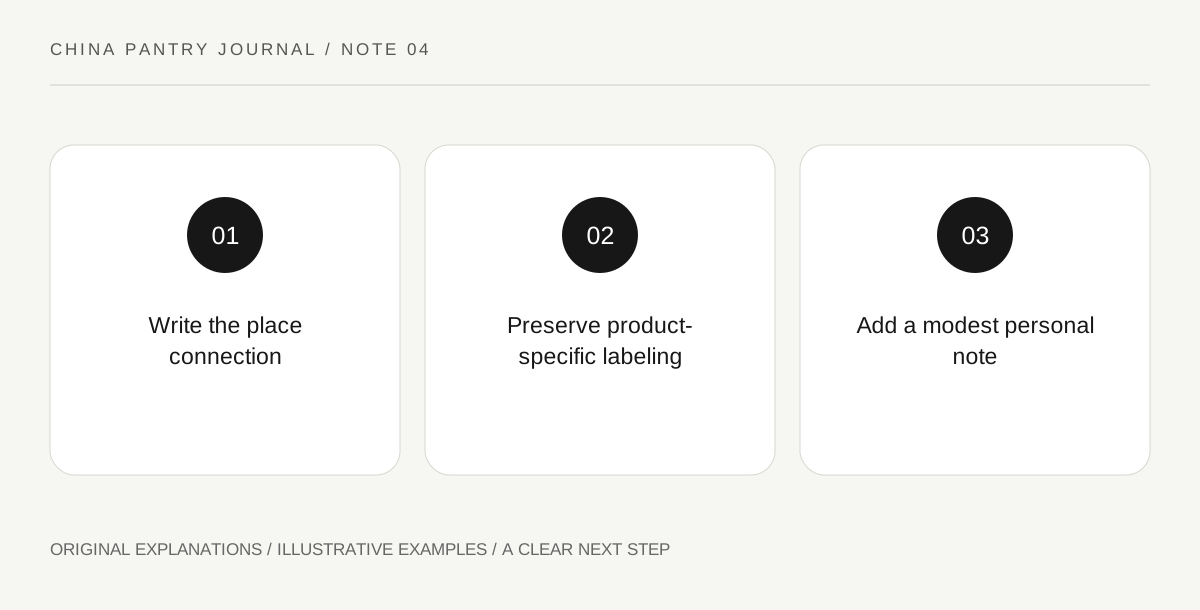
Original explanatory diagram. Read the full method and limitations below.
Keep the cultural introduction brief
Shanghai’s official page presents pear-syrup candies associated with the City God Temple as a traditional local product. That supports a concise place connection. It does not establish the complete recipe, medical effect or age of every brand sold nearby. Start the gift card with the product name and its Shanghai association, then move to the specific package. A short accurate introduction is more welcoming than a dramatic story whose details you cannot support. The recipient can enjoy the connection to a place without being asked to believe an embellished historical claim.
Let the package answer product questions
Record the producer, exact variety and the ingredient and storage information that accompanies the purchase. Preserve the original label when translating a few practical points for a friend. A familiar English name may not convey the same details as the manufacturer’s actual description. If something important is unclear, ask the seller before buying rather than using an attractive tin as evidence of what is inside. The gift card should direct the recipient back to the package for product-specific information, especially if several varieties share similar decorative packaging.
Explain the scale of the gift
Decide whether the candy is a personal treat, a small shared addition to a gathering or part of a broader food gift. That decision affects packaging and the note more than a universal number of pieces per person. For a shared setting, keep individually identified products together and allow people to decline without explanation. A gift is more considerate when it does not depend on everyone eating the same thing. You can pair the candy with a postcard or a small description of the visit so that the place connection remains available even to someone who chooses not to eat it.
Write about taste with ordinary language
If you sample a suitable product yourself, describe your immediate impression and identify the particular variety. Do not turn a personal response into a claim that the candy treats a throat problem or produces a health benefit. A culinary gift note can discuss sweetness, aroma or how the product is packaged without pretending to be a medical recommendation. End with a practical invitation: read the label, try it if it suits you, and keep the place story. That is enough to make a modest souvenir feel thoughtful and specific.
Illustrative food notebook
Illustrative gift card: “Pear-syrup candy from Shanghai; the official cultural introduction connects this tradition with the City God Temple area. This box is the named producer’s labeled variety. Please keep and read the original ingredient and storage panel.” The buyer adds a personal sentence about the packaging and a postcard from the trip. No treatment claim or invented family recipe is attached.
Questions that come up
Does a traditional name prove a medicinal benefit?
No health effect is established by a product’s traditional association in this article. Treat the purchase as food and use appropriate professional information for medical concerns.
Is an edible souvenir still thoughtful if a recipient does not eat it?
It can be when the gift includes a place story and no pressure. A postcard or short note lets the cultural connection stand independently of consumption.
References and scope
These sources support the factual background. Examples and exercises are original illustrative teaching material. References do not imply endorsement.
- Shanghai: Pear Syrup Candies — The traditional Shanghai association with the City God Temple; no medical claim or universal recipe.