Mango pomelo sago: map fruit, base and small pearls
A colorful dessert bowl can appear to be one blended flavor while containing several distinct kinds of texture. Mango pomelo sago is a useful composition lesson: map the named fruit, surrounding base and small pearl-like elements separately. The grid helps you understand the particular serving without expecting every shop to use the same balance.
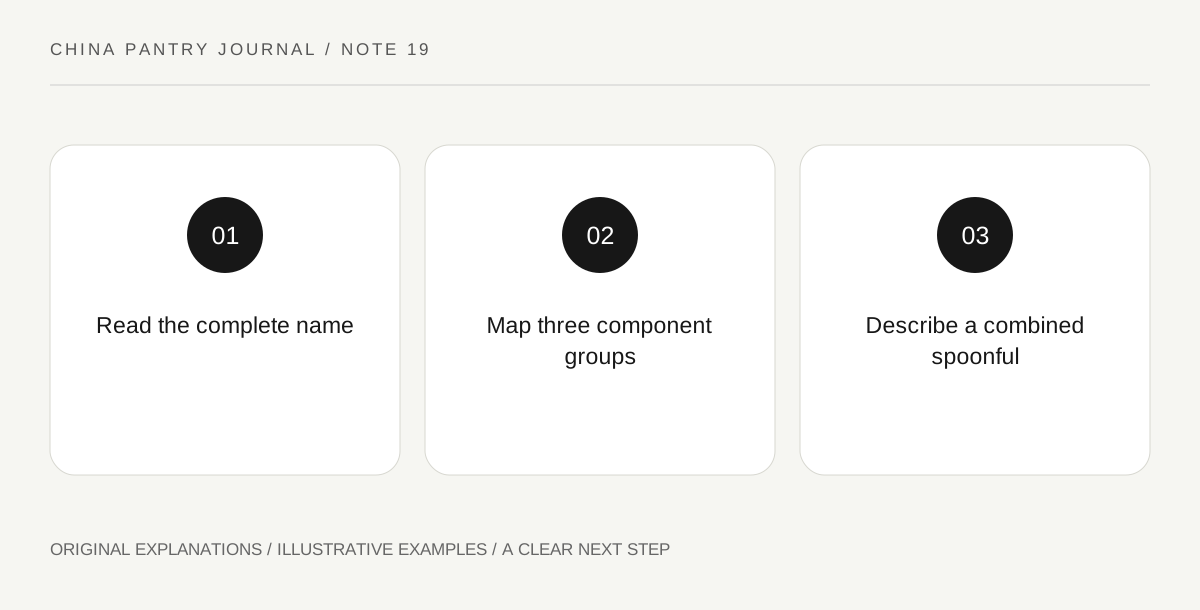
Original explanatory diagram. Read the full method and limitations below.
Keep the complete name visible
Hong Kong Tourism Board identifies mango pomelo sago as a chilled dessert containing distinct fruit elements within a surrounding preparation. Use the complete menu name rather than shortening it to mango pudding if that loses information the seller is trying to convey. Ask what the actual version contains and how it is presented. A translated dessert word can cover both a set preparation and a spoonable bowl, so the specific kitchen description is more informative than a category you infer from another product’s package.
Make three component fields
Create fields for larger fruit pieces, surrounding base and the smaller elements identified by the kitchen. Place observations in the right field rather than writing one adjective across the entire bowl. You might notice different sizes, resistance or distribution, but let the serving supply those details. The grid makes room for combinations that change across spoonfuls. It also prevents a visible fruit piece from becoming evidence for the complete formulation of the liquid beneath it, which requires actual product information.
Compare spoonfuls as combinations
After noticing the components, compare a spoonful dominated by one element with a spoonful containing more of the mixture, if that happens naturally as you eat. This is not a demand to dissect the dessert or calculate ratios. It is a way to understand why a composed bowl can feel varied even when the menu presents one name. A personal preference for more fruit or more base is just that: a preference. It does not establish that a different balance is a defective example of the category.
Use the grid to ask a clear ordering question
On a future visit, the grid can help you explain what you liked or ask what differs about another named option. Keep any request within what the establishment actually offers. If ingredients matter to your needs, ask directly rather than deriving them from color, creaminess or a photograph. Finish with the exact version and one combination you enjoyed. The record becomes useful across shops because it describes the decision and experience without pretending that all mango desserts are interchangeable or that a single bowl defines a universal recipe.
Illustrative food notebook
Illustrative grid: a diner records the shop’s identified fruit components in one column, the stated base in another and the small elements in a third. Two naturally different spoonfuls reveal a contrast in composition. The final note says which combination the diner preferred and retains the exact menu name, making the next order clearer without turning personal taste into a quality rule.
Questions that come up
Does a creamy appearance prove the base contains one particular milk?
No. Appearance cannot establish the formulation. Ask the kitchen or read product information for the actual preparation.
Is every mango dessert equivalent to mango pomelo sago?
No such equivalence is established. Use the full name and composition to distinguish different menu items rather than shortening all of them to one fruit word.
References and scope
These sources support the factual background. Examples and exercises are original illustrative teaching material. References do not imply endorsement.
- Hong Kong Tourism Board: 6 Must-Try Traditional Hong Kong Desserts — The named chilled dessert and its distinct fruit and surrounding-base format; original component exercise.